Ubuntu Server
A Self-Hosted Cloud Platform on Ubuntu — blog
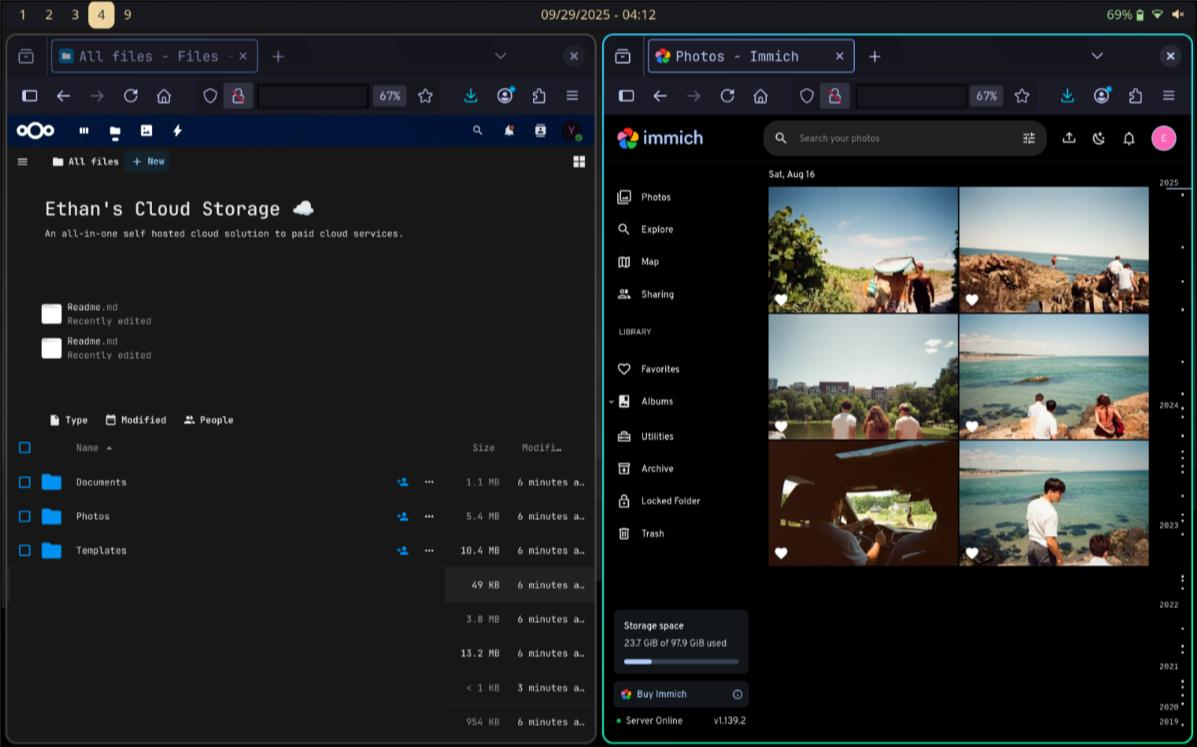
Fig. 1 The two services that replace the subscriptions: Nextcloud (left) for files, Immich (right) for photos.
This is a single Ubuntu Server box called omen-server. This runs the paid cloud services I
used to rent. Immich replaces Google Photos, Nextcloud replaces Drive and Dropbox, and
a Minecraft server replaces a rented game host. All three run as Docker Compose stacks
on roughly 1.5 TB of LVM-backed storage, and moving to self-hosted solutions has
saved me about $150 a year.
This machine was also the first node of what is now a seven-node k3s cluster, and it still runs the control plane. The Proxmox Datacenter VMs joined it later as workers. A Datadog agent stack, installed with Helm, collects logs from every node and raises alerts when a node or pod goes unhealthy.
What it replaced
| Subscription | Replaced by | Annual cost |
|---|---|---|
| Google Photos | Immich | $92.99 |
| Google Drive | Nextcloud | $18.99 |
| Minecraft Server Hosting | Minecraft container | $95.88 |
| Total | ~$150 |
Tab. 1 Final cost is calculated after subtracting ~$50 for electricity costs.
Design Decisions
LVM for storage
The disks are pooled with LVM rather than partitioned directly. A logical volume spans physical drives and resizes without repartitioning, so Immich’s library volume can grow as the photo count does instead of being sized once up front. This makes adding a disk simpler as you just need to extend the volume group instead of migrating data.
Docker Compose, not k3s, for the apps
Immich, Nextcloud and Minecraft each live in their own directory as a
docker-compose.yml. They are single-host services with no need for scheduling or
rolling updates, and Compose keeps backup easy.
Layered access with no public ports
Nothing is forwarded at the router. Remote access is three layers: SSH accepts keys only, UFW denies inbound by default, and Tailscale puts the machine on a WireGuard mesh. Every service is reachable only from inside the tailnet, so the exposed surface from the public internet is a closed set of ports.
Implementation
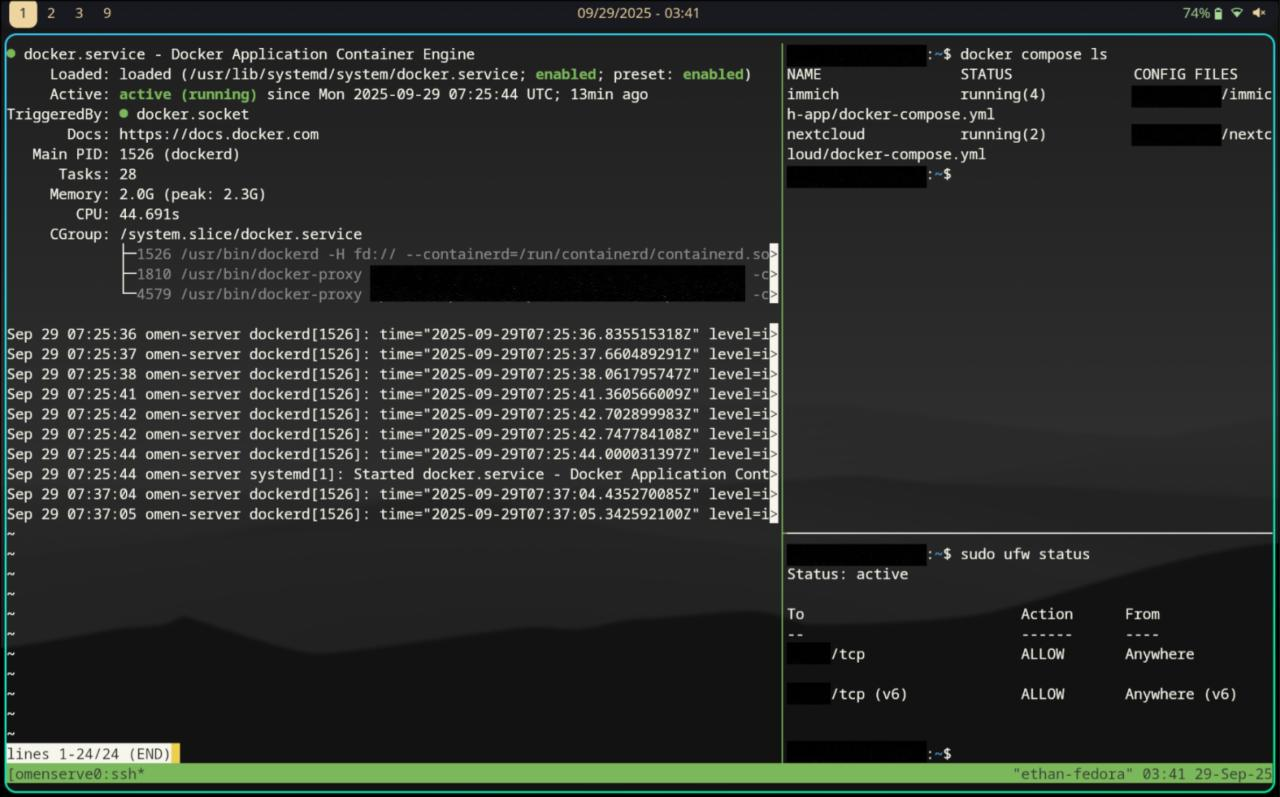
Fig. 2 Left: docker.service up. Right: docker compose ls (Immich and Nextcloud shown) and ufw status active.
The Compose layout
Each app is a directory with its docker-compose.yml and a bind mount onto the LVM
volume for its data:
/srv/
├── immich/       docker-compose.yml  →  /mnt/data/immich
├── nextcloud/    docker-compose.yml  →  /mnt/data/nextcloud
└── minecraft/    docker-compose.yml  →  /mnt/data/minecraft
k3s control plane on Omen
Internet
    │  (no port forwarding — access via Tailscale)
    ▼
Tailscale mesh (WireGuard)
    ▼
omen-server ── UFW ── static LAN IP
    ├── Docker Compose:  Immich · Nextcloud · Minecraft
    └── k3s control plane
          ├── Raspberry Pi 4        ARM worker
          └── 5× Proxmox R510 VMs   x86 workers
Observability with Datadog
As the cluster grew past one node, an observability stack (Datadog agents) was implemented. The agent runs as a DaemonSet, so every node ships logs and metrics, and monitors when a node stops reporting or a pod crash-loops. This makes failures show up as an alert instead of as a service that quietly went down.
Results

Fig. 3 kubectl get nodes, the control plane on omen-server, the Raspberry Pi, and five R510 VMs, all Ready.
What’s Next?
- Move Immich and Nextcloud from Compose onto k3s for automatic updates.
- GitOps for the Datadog values and the workload manifests.